hyperf 3.1 中间件
一、创建中间件:
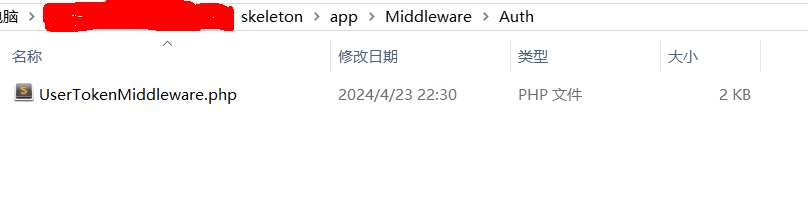
所有的中间件都会被默认创建到app/Middlware目录下
php bin/hyperf.php gen:middleware Auth/UserTokenMiddleware
$ php bin/hyperf.php gen:middleware Auth/UserTokenMiddleware
[DEBUG] [command] Commands registered by Hyperf\Command\Listener\RegisterCommandListener
[DEBUG] Event Hyperf\Framework\Event\BootApplication handled by Hyperf\Command\Listener\RegisterCommandListener listener.
[DEBUG] Event Hyperf\Framework\Event\BootApplication handled by Hyperf\Config\Listener\RegisterPropertyHandlerListener listener.
[DEBUG] Event Hyperf\Framework\Event\BootApplication handled by Hyperf\DbConnection\Listener\RegisterConnectionResolverListener listener.
[DEBUG] Event Hyperf\Framework\Event\BootApplication handled by Hyperf\ExceptionHandler\Listener\ExceptionHandlerListener listener.
[DEBUG] Event Hyperf\Framework\Event\BootApplication handled by Hyperf\ExceptionHandler\Listener\ErrorExceptionHandler listener.
App\Middleware\Auth\UserTokenMiddleware created successfully.
二、中间件的使用
1、定义全局中间件:在config/autoload/middlewares.php下定义
return [
    'http' => [
        App\Middleware\Auth\UserTokenMiddleware::class,
    ],
];
2、定义局部中间件
2.1、在路由里定义:在config/routes.php
Router::addRoute(['GET', 'POST', 'HEAD'], '/test', 'App\Controller\IndexController@test',
    ['middleware' => [
        \App\Middleware\Auth\UserTokenMiddleware::class
    ]
]);
2.2、在控制器里定义:当路由的定时方式是注解的时候才可以实现
#[Middlewares]:定义多个中间件,用{}包裹
#[Middleware]:定义单个中间件
使用 #[Middleware] 注解时需 use Hyperf\HttpServer\Annotation\Middleware; 命名空间;
使用 #[Middlewares] 注解时需 use Hyperf\HttpServer\Annotation\Middlewares; 命名空间;
注意:必须配合 #[AutoController] 或者 #[Controller] 使用
<?php

declare(strict_types=1);

namespace App\Controller;

use Hyperf\HttpServer\Annotation\Controller;
use Hyperf\HttpServer\Annotation\Middleware;
use Hyperf\HttpServer\Annotation\RequestMapping;

#[Controller(prefix: 'user')]
#[Middleware(\App\Middleware\Auth\UserTokenMiddleware::class)]
//#[Middlewares([FooMiddleware::class, BarMiddleware::class])]
class ClientController extends AbstractController
{
    #[RequestMapping(path: 'index', methods: 'get')]
    public function index()
    {
        $user = $this->request->input('user', 'Hyperf');
        $method = $this->request->getMethod();

        return [
            'method' => $method,
            'message' => "Hello {$user}.",
        ];
    }
}
定义方法级别中间件
只需将注解直接定义到方法上即可。类级别上的中间件会优先于方法级别的中间件,我们通过代码来举例一下:
<?php
namespace App\Controller;

use App\Middleware\BarMiddleware;
use App\Middleware\FooMiddleware;
use Hyperf\HttpServer\Annotation\AutoController;
use Hyperf\HttpServer\Annotation\Middleware;
use Hyperf\HttpServer\Annotation\Middlewares;

#[AutoController]
#[Middlewares([FooMiddleware::class])]
class IndexController
{
    #[Middleware(BarMiddleware::class)]
    public function index()
    {
        return 'Hello Hyperf.';
    }
}
多个中间件的执行顺序:全局中间件→类级别中间件→方法级别中间件
三、中间件的内容的编写
<?php

declare(strict_types=1);

namespace App\Middleware\Auth;


use Hyperf\HttpServer\Contract\RequestInterface as Request;
use Hyperf\HttpServer\Contract\ResponseInterface as Response;
use Psr\Container\ContainerInterface;
use Psr\Http\Message\ResponseInterface;
use Psr\Http\Server\MiddlewareInterface;
use Psr\Http\Message\ServerRequestInterface;
use Psr\Http\Server\RequestHandlerInterface;

class UserTokenMiddleware implements MiddlewareInterface
{
    protected $container;
    protected $response;
    protected $request;

    public function __construct(ContainerInterface $container, Response $response, Request $request)
    {
        $this->container = $container;
        $this->response = $response;
        $this->request = $request;
    }

    public function process(ServerRequestInterface $request, RequestHandlerInterface $handler): ResponseInterface
    {
        //return $handler->handle($request);

        // token验证
        $checkToken = false;
        if ($checkToken) { // 验证成功继续往下请求
            return $handler->handle($request);
        } else { // 验证失败直接返回json内容
            return $this->response->json(
                [
                    'code' => -1,
                    'data' => [
                        'error' => '中间里验证token无效,阻止继续向下执行',
                    ],
                ]
            );
        }
    }
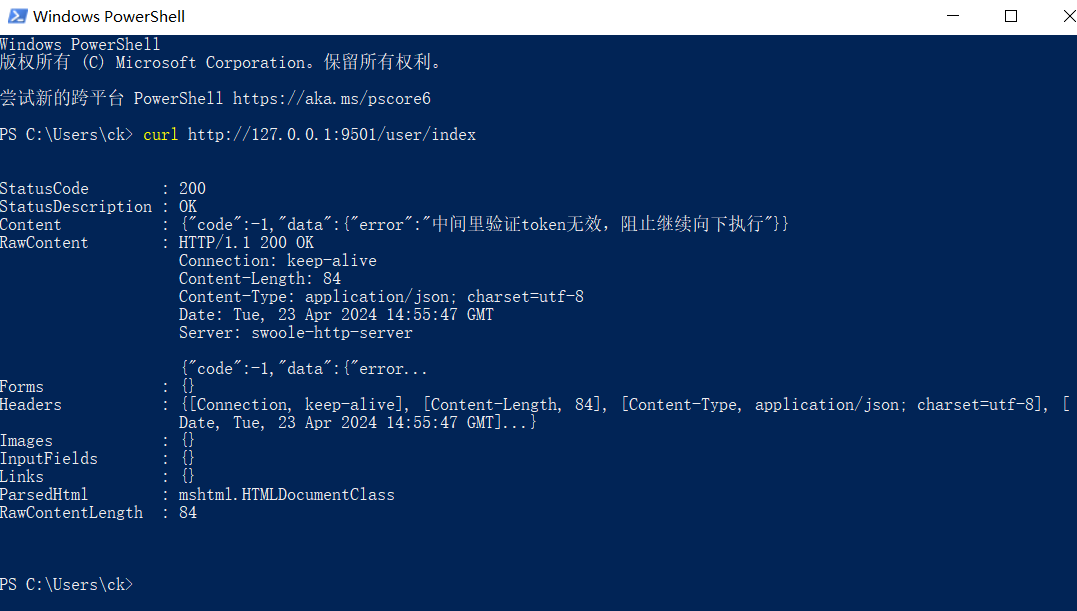
}
本文为崔凯原创文章,转载无需和我联系,但请注明来自冷暖自知一抹茶ckhttp://www.cksite.cn
- 上一篇: hyperf 3.1 请求与响应
- 下一篇: hyperf 3.1 路由

请先登录后发表评论
- 最新评论
- 总共0条评论